
Booking a ski transfer: what to check before you pay
A ski transfer is one of the few holiday purchases where the advertised price and the final price routinely differ, and where the cheapest quote is often the most expensive journey. Here are the eight things worth checking before you pay, why each of them matters on a mountain road in February, and the questions that get you a straight answer.
Alps Ski Transfers
Transfers look like a commodity: two points, one vehicle, a price. They are not, and the differences only show up on the day — when the flight is two hours late, when there are more ski bags than the vehicle takes, or when the toll turns out not to be included.
1. Per vehicle or per person?
This is the first question, and it changes everything. A private transfer is priced per vehicle: four people or eight, the price is the same, tolls included. What you are buying is the whole car and the whole journey, not a seat in it.
So when you compare quotes, check the unit before the number. A headline “from £35” and a flat £210 look very different on a search page and can end up identical once you multiply — and only one of the two takes you straight to your door at the hour you actually land.
2. Are the tolls in the price?
On Alpine routes the tolls are not trivial. The Mont Blanc tunnel and the Fréjus tunnel each cost a substantial sum for a minibus, the Swiss motorway vignette is an annual charge on the vehicle, and French motorways charge by axle. A quote that excludes them is not a quote, it is an estimate.
Ask plainly: does this price include the tunnel and all tolls? The answer should be yes and it should be in writing.
3. Do ski bags cost extra?
Some operators charge per ski bag, others include them, and a few quietly size the vehicle on seats alone — which is how six people with six ski bags and six boot bags end up holding equipment on their knees for two hours.
Declare exactly what you are bringing: skis, boards, boot bags, a splitboard, a pushchair, an airbag pack. A serious operator uses that to choose the vehicle, not to add a surcharge.
4. What happens if the flight is late?
Winter flights to Alpine airports are delayed often — weather at both ends, de-icing queues, a diversion to another airport. The question is what the operator does about it.
- Does the driver track the flight, or work to the time you booked?
- How much waiting time is included, and what happens after it?
- Is there a number that a human answers at eleven at night?
- What happens if the flight is diverted to another airport entirely?
- Is there a charge for any of the above?
Flight tracking should be standard and free. If waiting time is charged by the quarter-hour, you are buying a taxi, not a transfer.
5. Child seats
France, Switzerland, Italy and Austria all require an approved restraint for children — in France, for every child under 10. Seats should be free, fitted before departure and matched to the ages you give at booking. A driver producing a booster cushion for a three-year-old at the kerb is a bad sign, and an illegal one.
6. Winter equipment on the vehicle
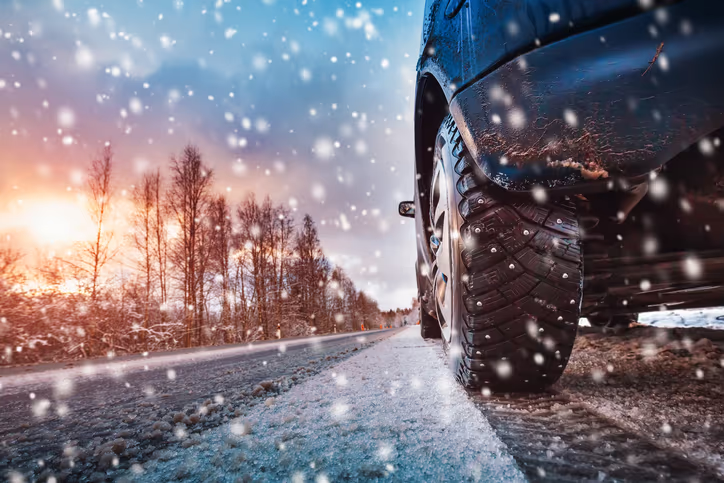
In Savoie and Haute-Savoie, winter tyres or chains are legally required from 1 November to 31 March; Austria applies a similar rule from 1 November to 15 April, and Italy on Alpine roads from mid-November to mid-April. Ask what the vehicle carries. On the climb to Val Thorens or Flaine in fresh snow, this is not a technicality.
7. The address, not the resort
Give the exact address of your accommodation when you book, not just the resort name. Several resorts are really two or three villages several kilometres apart — Crans and Montana, Flims, Laax and Falera, Recoin and Roche-Béranger at Chamrousse, Le Fayet and Saint-Gervais village. And some resorts cannot be driven into at all: Zermatt, Wengen and Mürren end at a station.
An operator who asks you for the address before quoting is one who has driven there.
8. Cancellation, and what is actually promised
Read the cancellation terms before you pay, and check what the confirmation actually says: the vehicle category, the number of passengers, the pick-up time, the address, the price and what it includes. A confirmation that says only « transfer to the Alps » is a dispute waiting to happen.
When to book
As soon as your flights are confirmed. In February the vehicles run out before the accommodation does, particularly for Saturday arrivals, and early bookings are cheaper. If your dates are flexible, arriving midweek saves an hour of traffic each way on the two roads that matter — the A40 towards Chamonix and the Tarentaise below Moûtiers — and usually saves money on the flight as well.
The one-line version
Compare per-vehicle prices with tolls, ski bags, child seats and waiting time included, give the exact address, and book when you book the flight. Everything else is detail — but those five things are the difference between a transfer that works and a holiday that starts badly.
Transfers mentioned
Resorts covered in this guide
Each one has its own page, with the drive time from every airport that serves it.
- 1.Get an instant quote — Use our online booking tool for a competitive rate.
- 2.Confirm your booking — Receive an immediate confirmation with all details.
- 3.Meet your driver — Enjoy a hassle-free airport transfer with an English-speaking driver.
- Our customer service is available 24/7 to assist with any request.